
Why russets win for crispy hash browns
The difference between a soggy breakfast patty and a shattering, golden crust comes down to starch density. Russet potatoes are the standard for hash browns because their high starch content creates a rigid structure that dehydrates efficiently under heat. When you shred a russet, the exposed starch granules gelatinize and then dry out, forming a crispy exterior shell that holds its shape.
Waxy potatoes, such as red or Yukon Gold varieties, contain significantly less starch and more moisture. Their cell walls remain intact and flexible during cooking, leading to a tender, creamy interior rather than a crunchy one. If you use waxy potatoes, the hash browns will steam in their own released juices instead of frying, resulting in a soft texture that collapses under a spatula.
The visual difference is immediate. Russets break down into fine, dry shreds that separate easily, allowing hot oil to penetrate every strand. Waxy potatoes hold together in clumps, trapping moisture inside the mass. This moisture barrier prevents the Maillard reaction from occurring evenly, leaving you with pale, steamed patches alongside burnt edges.
Shredding technique and moisture control
The difference between a golden, lace-like crust and a soggy, steamed mess comes down to two variables: shred geometry and water content. Potatoes are roughly 80% water by weight. When you drop wet shreds into a hot skillet, that water must evaporate before the surface temperature can rise high enough to trigger the Maillard reaction—the chemical process that creates browning and crispness. If you skip the drying step, you are essentially boiling your breakfast in potato juice.
Choose the right shredder
A box grater works in a pinch, but a food processor with a shredding disc offers consistency. Uniform shreds cook at the same rate, preventing some pieces from burning while others remain raw. If you are using a box grater, apply even pressure and rotate the potato to maintain consistent strand length. Avoid the fine grating side; it creates a mushy paste rather than distinct strands that can separate and crisp individually.
The squeeze technique
Once shredded, transfer the potatoes to a clean, lint-free kitchen towel or a nut milk bag. Gather the edges and twist tightly over the sink. You need to apply significant torque to force the water out. For medium-sized potatoes, you should see a steady stream of liquid, not just dampness. If the water looks cloudy with starch, you can rinse the shreds under cold water, but you must dry them again thoroughly before cooking. Some cooks prefer to rinse to remove excess surface starch for a crunchier exterior, while others keep it for a softer interior. For maximum crispiness, a quick rinse followed by a rigorous squeeze is the diner standard.
Check for dryness
After squeezing, the potato shreds should feel cool and dry to the touch, with no visible moisture dripping from the cloth. If they clump together wetly, you need to squeeze longer. A good rule of thumb: if the towel is heavy with water, you are on the right track. If the shreds look pale and limp, that is a good sign—wet potatoes look glossy; dry potatoes look matte. This step is non-negotiable. Even a few tablespoons of retained water will lower the skillet temperature and steam the exterior, preventing the formation of that critical crispy crust.
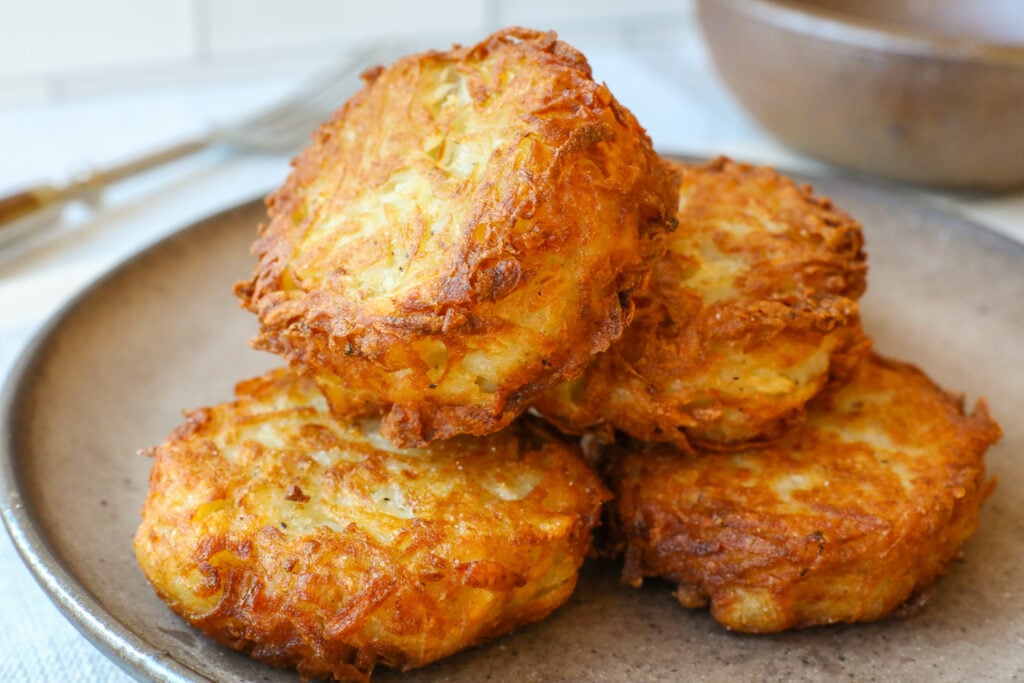
Use the medium-sized holes on a box grater or the shredding disc on a food processor. Aim for uniform strands about 1/4 inch long. Avoid fine grating, which creates a paste-like texture that steams rather than crisps.
Place the shreds in a clean kitchen towel or nut milk bag. Gather the edges and twist tightly over the sink, applying significant torque. You should see a steady stream of liquid, not just dampness. This removes the water that would otherwise steam the potatoes.
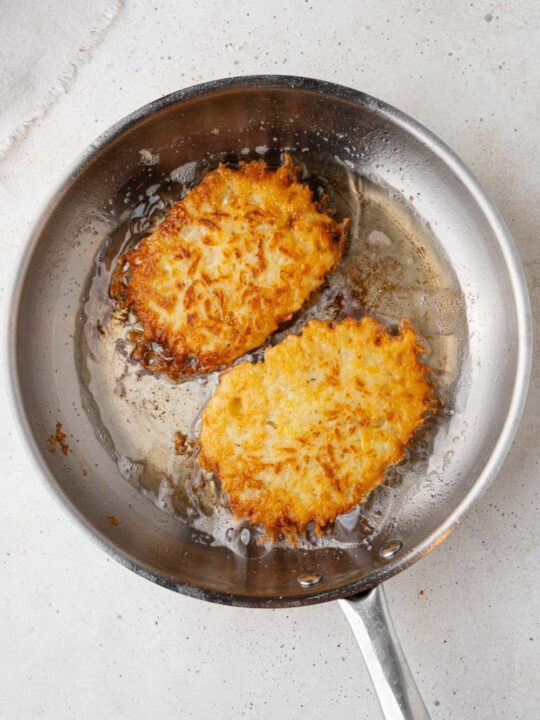
The shreds should feel cool and dry to the touch, with no visible moisture. Wet potatoes look glossy; dry potatoes look matte. If they clump together wetly, squeeze longer. This dry, matte appearance is essential for achieving a golden crust.
-
Shreds are uniform in length (approx. 1/4 inch)
-
Towel is heavy with extracted water
-
Shreds feel dry and matte, not glossy or damp
-
No visible liquid dripping from the cloth
Skillet heat management and fat choice
The to Crispy Hash Browns works best as a clear sequence: define the constraint, compare the realistic options, test the tradeoff, and choose the path with the fewest hidden costs. That order keeps the advice usable instead of decorative. After each step, pause long enough to check whether the recommendation still fits the reader's actual situation. If it depends on perfect timing, unusual access, or a best-case budget, include a simpler fallback.
The simplest way to use this section is to write down the real constraint first, compare each option against it, and choose the path that still works outside ideal conditions.
Timing and flipping for structural integrity
Crispy hash browns rely on thermal dynamics, not luck. The goal is to evaporate surface moisture until the potato starches gelatinize and then caramelize. Rushing this process traps steam, resulting in soggy, pale patties that fall apart when cut.
Heat your cast iron skillet over medium-high heat until a drop of water sizzles and dances across the surface. Add enough oil to coat the bottom generously; the oil acts as a heat conductor and a barrier against sticking. Once the oil shimmers, add your shredded potatoes in an even layer. Press them down firmly with a spatula to maximize surface contact with the hot metal.
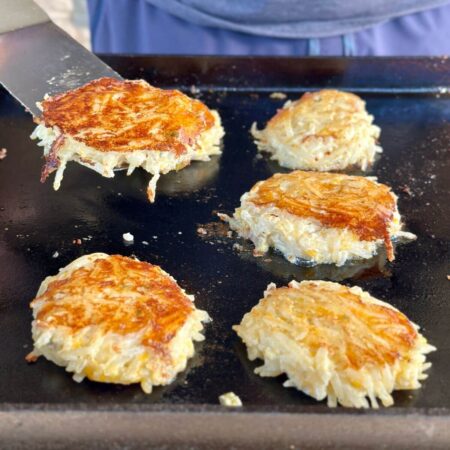
Let the hash browns cook undisturbed. This is the most critical phase. You are waiting for the Maillard reaction to occur on the bottom layer. This typically takes 7 to 10 minutes. Watch for the edges to turn golden brown and begin to lift slightly from the pan. If you try to flip too early, the structure will collapse.
The single-flip method
Professional chefs often recommend a single flip for home cooks to preserve texture. Using a large, flat spatula, carefully turn the entire patty over. If your skillet is too large for one flip, divide the mixture in half. Cook the second side for another 5 to 7 minutes until deeply golden and crisp.
Avoid poking or prodding the hash browns while they cook. Each disturbance releases moisture and breaks the forming crust. Patience here pays off in a shattering crunch and a cohesive interior. Once both sides are done, transfer them to a wire rack or paper towel-lined plate to drain excess oil immediately.
-
u0027Dry shredded potatoes thoroughly\u0027
-
u0027Preheat skillet until shimmering\u0027
-
u0027Press potatoes into an even layer\u0027
-
u0027Cook undisturbed for 7-10 minutes\u0027
-
u0027Flip only once for best texture\u0027
Troubleshooting soggy or burnt results
Even with the right shredder and a heavy skillet, hash browns can fail if thermal dynamics or moisture control are off. Sogginess almost always comes from excess water steaming the potatoes instead of frying them. Burning happens when the pan is too hot or the potatoes are too thin, causing the starches to carbonize before the interior cooks.
Fixing sogginess
The primary enemy of crispness is moisture. If your shredded potatoes feel wet to the touch, they will steam. Squeeze them in a clean kitchen towel until no more liquid comes out. If you are short on time or still feel dampness, toss the shreds with one tablespoon of cornstarch per pound of potatoes. The starch absorbs residual water and creates a crispier exterior layer.
Preventing burning
Use medium heat, not high. High heat burns the outside while the inside remains raw. Cook for 10 to 15 minutes, pressing the patty flat to ensure even contact with the pan. If the bottom darkens too quickly, lower the heat and cover the pan for two minutes to let steam finish cooking the interior.
Handling frozen hash browns
Frozen shreds release significant water as they thaw. Do not thaw them completely in a bowl, which pools water. Instead, cook them straight from the freezer in a preheated skillet. Break up large clumps with a spatula as they soften. You may need to add a minute or two to the cooking time to evaporate the extra ice melt.
No comments yet. Be the first to share your thoughts!